Europe/Cross-border cooperation: what is the Greater Region?
Since 20 January 2021, the Grand-Est Region has held the presidency of the Grande Région, a cross-border area of almost 12 million inhabitants, a laboratory for European integration in the economic and social fields.
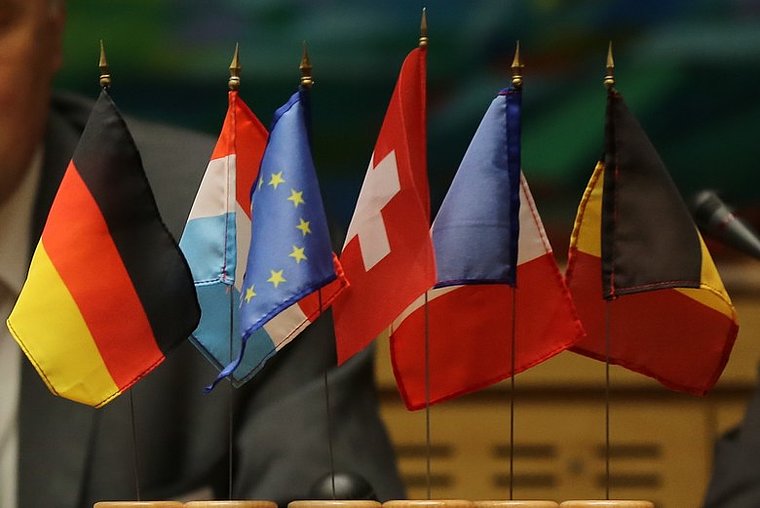
The idea of strengthening collaboration between the territories of the "mining triangle" (Saarland, Lorraine, Luxembourg) emerged at the end of the 1960s. Impelled by German Chancellor Kiesinger and General de Gaulle in the form of intergovernmental cooperation, the Greater Region has since been institutionalised and extended to include other territories.
Who are the members of the Greater Region?
The Greater Region is today a cooperation area that brings together six territories from four different countries: the Länder of Saarland and Rhineland-Palatinate (Germany), Wallonia, the Wallonia-Brussels Federation and the German-speaking Community of Belgium (Belgium), the whole of the Grand Duchy of Luxembourg (Luxembourg) and Lorraine (now part of the Grand Est region).
What does the Greater Region do?
Since 1995, the ambition of the Greater Region has been to build a more integrated area in the economic and social fields and to make this cross-border area a laboratory for European integration. "Ifcross-border cooperation is the driving force of European integration, then the Greater Region is the laboratory for it", says the website.
The Greater Region acts in the following fields:
- Mobility and territorial development
Several initiatives have been taken to improve rail links between the main cities in the region. This is notably the case of the "Eurocaprail" project, which aims to develop the Brussels-Luxembourg-Strasbourg axis and connect Metz and Luxembourg to nearby European capitals.
- Education and lifelong learning ;
Since 2003, the Schuman programme has enabled pupils from one school to stay for two weeks in a school in another country, in order to encourage the development of a cross-border culture. A German-Luxembourgish high school called Schengen was also set up in 2007 in the German town of Perl and aims to promote the acquisition of language skills for better integration into the labour market.
- Economy and competitiveness ;
The Greater Region is working in particular to reduce administrative constraints on both sides of the borders and, in response to the Covid-19 pandemic, to promote teleworking and harmonise short-time working arrangements so as not to discriminate against cross-border workers.
- Tourism and culture ;
- Society, citizenship and security ;
- Environment and sustainability ;
The Greater Region in figures
In 2020, the Greater Region is...
11.7 million inhabitants
65,400 km² of surface area
412 billion euros in GDP
5.3 million people in employment
The Grande Région is financed by the European budget within the framework of the EU cohesion policy and in particular the European Regional Development Fund (ERDF). The latter provides funding for inter-regional programmes (Interreg) aimed at stimulating cooperation between European territories, including the Interreg Grande Région programme. For the period 2014-2020, the latter has been allocated a total budget of €234.6 million, comprising €139.8 million in Community funds and €94.8 million from governments.
What are its institutions?
From 1969 onwards, intergovernmental commissions were held from time to time, bringing together foreign ministers and/or regional representatives. In 1980, an agreement was concluded to formalise cooperation. This legal act founded the Greater Region and institutionalised the meetings. The first summit of the new Grande Région was held in Mondorf-les-Bains in 1995, on the initiative of Jean-Claude Juncker, then Prime Minister of Luxembourg, and Oskar Lafontaine, Minister-President of the Saarland.
"TheEuropean idea is gaining ground.Never before has there been such a chance to achieve an ever closer union between the peoples of Europe. Theterritories along the internal borders play a special role in this integration process: it is above all here that Europe is being built".
(Excerpt from the first Joint Declaration of the Summit; Mondorf-les-Bains, 1995)
To manage the day-to-day cooperation between its members, the Greater Region now has several bodies:
- The Executive Summit of the Greater Region
The Summit is the political decision-making body that brings together the heads of the executives of the member territories: Minister-Presidents (Belgium and Germany), President of the Regional Council and Prefect of the Region (France), Minister for the Greater Region and Prime Minister (Luxembourg).
Assisted by a secretariat, it also oversees the work carried out by the various working groups. Each member takes it in turn to chair the Summit for a period of two years. Since1 January, the Greater East Region has held the presidency for the period 2021-2022.
- The Interregional Parliamentary Council (ICC)
A consultative body, composed of members of the regional (Germany and Belgium), national (Luxembourg) or regional (France) parliaments, it issues recommendations in various fields which are then transmitted to the Summit. The work is carried out within the framework of thematic committees.
- The Economic and Social Committee of the Greater Region (CESGR)
CESGR is a second consultative body made up of experts and the economic and social partners. Like the European Economic and Social Council, it is made up of three groups: employer representation, trade union representation and civil or administrative society. The Committee issues opinions and resolutions on economic, social, cultural and spatial planning issues. It also works on the Greater Region's territorial development plan.
Other structures have also been set up for the implementation of certain projects, such as the Maison de la Grande Région, the Robert Schuman European Centre and the Border Task Force.
What ambition for the French Presidency?
Since 20 January 2021, the Greater East Region has held the rotating presidency of the Executive Summit for the next two years. Its slogan to guide its action is: "the GreaterRegion, crossroads of Europe, an innovative, resilient and supportive space". On the occasion of the 17th Summit of the Greater Region's Executives, the President of the Regional Council, Jean Rottner, indicated four priority areas of action to continue the work carried out under the last presidencies and to respond "to a changing and transforming world":
- Transforming territories to regain industrial sovereignty and encourage applied medical research and new forms of energy;
- Enhancing common resources such as water, where resources are shared between Meuse, Moselle and Saarland, through support for the emergence of short consumption circuits or the protection of biodiversity and natural areas via the Natura 2000 network;
- Connecting territories and citizensto guarantee the mobility of inhabitants in the cross-border area and to integrate them into a common living space. This involves both adapting training in the Greater Region to meet changes in the labour market and supporting mobility and culture with the preparation of Esch sur Alzette (Luxembourg), designatedEuropean Capital of Culture for 2022. A means of supporting the cultural, tourism and events sectors in the cross-border area;
- Protecting the inhabitants by strengthening cooperation initiatives between the regions, both in terms of public health and safety and civil protection.
In addition to the fight against the Covid-19 pandemic and its consequences, other themes will also be highlighted in the next two years, such as the development of cooperation in the digital field, support for research and sustainable mobility, the integration of the labour market or the development of a long-term global territorial strategy to set the main guidelines for the Greater Region's project.
Source: www.touteleurope.eu/