Benin/CELEBRATION OF INTERNATIONAL YOUTH DAY - Benin's youth set the tone for the Benin 2060 Vision in Cotonou
In the Blue Room of the Palais des Congrès, the Benin Youth Parliament (PJB) organized the very first celebration of International Youth Day (IYD) from September 4 to 5, 2026. Held under the patronage of the President of the National Assembly (AN), Professor Joseph Fifamin Djogbénou, the event’s theme was “Youth and Vision Benin 2060 Alafia: Building Tomorrow’s Benin Today.” Far from being a mere ceremonial gathering, the event is part of an effort to promote the human capital represented by Benin’s youth. As a result, parliamentarians, representatives from UNICEF and the World Bank, government officials, leaders of youth organizations, and young people from various regions of the country attended the event.
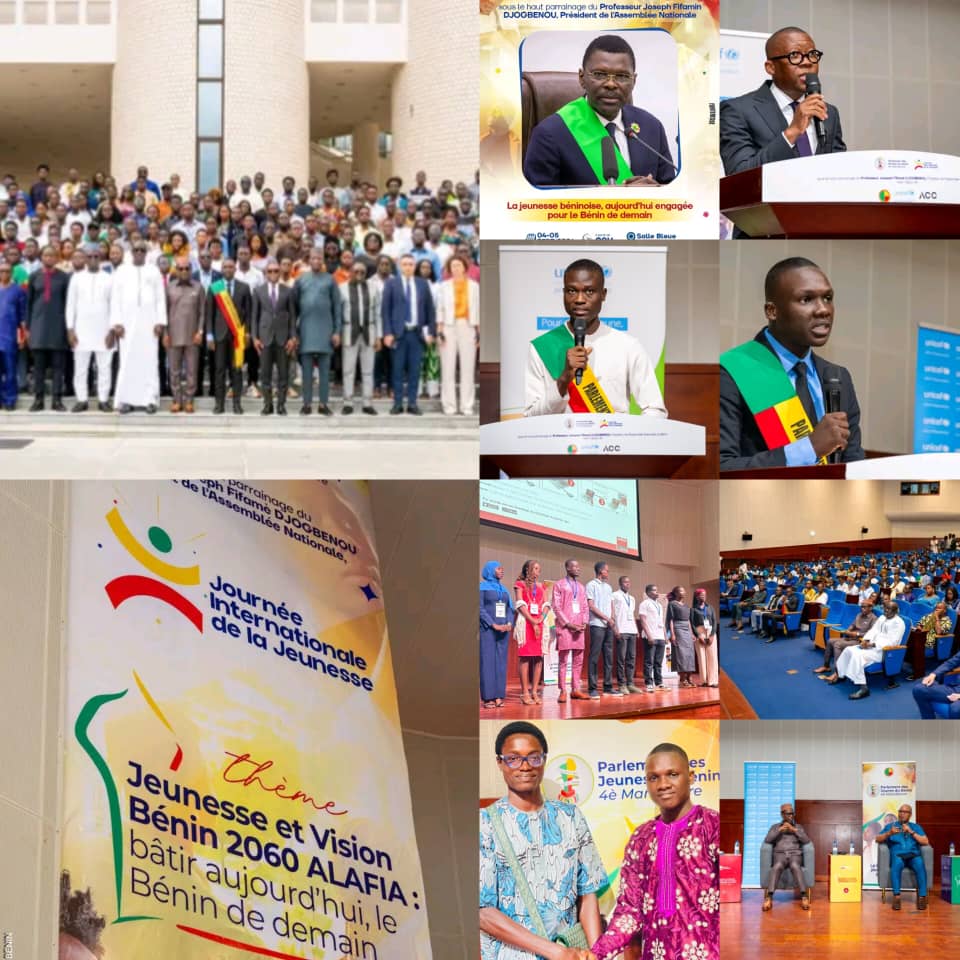
Making young people partners, not just beneficiaries. Christel-Fourrier Donkpégan, the Administrative Secretary-General (SGA) of the AN, opened the discussions on behalf of the institution’s president. According to him, Benin’s youth have moved beyond the status of “tomorrow’s leaders” to become, as of now, “a driving force of the nation.” Drawing on the country’s demographic advantage, he noted that young people’s expectations—whether regarding dignity, access to quality education, decent employment, or participation in civic life—are shared throughout the country, from Cotonou to Natitingou, via Parakou, Porto-Novo, and rural areas. In his view, “the Benin of 2060 will be the direct result of society’s current direction, managed and led by today’s youth.” This observation has led him to call on the public administration to treat young people as responsible partners rather than mere recipients of programs.
The chairman of the organizing committee, Ruben Abikou, for his part, brought the year 2060 back to an immediate reality: “2060 is not a distant deadline; it is part of our own lives. What are we doing today to ensure that the Benin of 2060 is truly the one we want? ” He further expanded on this call to action by directly addressing the audience: “What are we doing today to ensure that the youth of 2060 do not face the same difficulties, the same sacrifices, and the same limitations that we face today? ” He took the opportunity to acknowledge the involvement of Professor Joseph Fifamin Djogbénou as a sponsor, the technical and financial support from UNICEF, as well as the contribution of the Ministry of Small and Medium-Sized Enterprises and Employment Promotion (SME/EP), the Cotonou City Hall, and the other partners who made this event possible.
Speaking on behalf of UNICEF Benin, Ousmane Niang emphasized the need to truly involve young people in shaping the policies that affect them, noting that “sustainable development for young people cannot be achieved without young people.” Such participation, he said, must be meaningful and not merely symbolic.
PJB President Guerschom Agbowakounou, for his part, outlined the strengths on which Benin can rely: its geopolitical position, its natural resources, the ongoing digital transition, and its young human capital. However, he was careful to temper this optimism: without excellence, integrity, and a sense of the common good cultivated starting today, this youth could become a hindrance rather than a driving force for the country’s development.
Day One: Two Panels to Spark Discussion
The first day then continued with two panel discussions that gave participants the opportunity to move beyond rhetoric and explore concrete solutions.
Moderated by journalist William Klikan, the first panel focused on the role and contribution of young people in building the Benin of tomorrow, within the framework of the Alafia Vision 2060. Participating in the panel were Representative Orden Alladatin, Chair of the Committee on Laws; Cyriaque Edon, Director of Development Policies; and Mohamed Aboubakari, a public finance specialist. Their remarks helped the young people in attendance better understand the institutional and budgetary mechanisms they could utilize to exert greater influence on public policy decisions.
The second panel, led by sociologist and anthropologist Fabrice Fifonsi, addressed issues related to education, employment, and entrepreneurship in light of the challenges of the future labor market. Contributors included Achille Ayowa, Director General of the National Employment Agency; Kolade Okoudjou, Chief of Staff to the Minister in charge of SMEs and microenterprises; and Dr. Gildas Nonnou, Deputy Director of the National School of Administration. Thanks to their insights, participants left with a better understanding of the available job placement programs, promising sectors, and practical steps for launching a business.
Day Two: Spotlight on Youth Talent and Projects
The final day, meanwhile, took a decidedly more practical turn, highlighting numerous talents and projects led by young Beninese people.
The first panel of the day, moderated by Grâce Amouzoun, chair of the PJB’s Social Affairs and Gender Commission, brought together Driss Bengeloune, Head of the Innovation Lab at MTN Benin, and Consolas Hodonou, a data scientist and ambassador for Women in AI & Data Academy, to discuss the theme “Innovation, Artificial Intelligence, and Digital Entrepreneurship: What Opportunities for Beninese Youth?” At the heart of the discussions was a simple yet central question: How can these technological opportunities be concretely transformed into tools for youth integration? In addition, a presentation on the UNICEF platform preceded the presentation of projects led by young entrepreneurs, who were invited to present their initiatives to the audience and to a jury tasked with evaluating them.
The second panel, moderated by Maésarath Raoufou, JMS Africa-Benin Ambassador and Young Leader of Benin, focused on “Culture, Citizenship, and Engagement: How Can We Make Youth Key Players in Cultural Influence and National Development?” Speakers included Fabroni Bill Yoclounon, a writer and specialist in the digitization of African languages; Godline Agbidinoukoun, a lawyer and activist; and Dieudonné Fanou, communications officer and cultural planner at the Chinese Cultural Center in Benin.
Following the discussions, a competition was held in which six teams of young project leaders presented their ideas to the jury. Three of these teams impressed the jury with the strength of their arguments and were recognized: Team Yonwa took first place, ahead of Innovations Online and Oasix.
A closing ceremony also provided the organizers with an opportunity to take stock of the two-day event.
Taking the floor, Pjb President Guerschom Agbowakounou thanked all the technical and financial partners—first and foremost UNICEF Benin and AN—for their support in making this event a reality. He specifically reflected on the project’s origins, noting that an initial attempt to organize the event the previous year had to be abandoned due to a lack of time and preparation, just a few weeks after the Youth Parliament was established in the chamber. Deliberately paraphrasing John F. Kennedy’s famous quote, he invited the audience to ask themselves not what the country can do for them, but what they can do for their country. In his view, the commitment shown by the participants over the course of these two days—despite their personal and professional constraints—demonstrates the ability of Benin’s youth to drive change themselves. He also set the goal for the next edition of the event to mobilize an even broader range of young people from all regions of the country.
The Deputy Secretary-General of the National Assembly, for his part, congratulated the members of the PJB and all the young participants for the quality of their reflections on Benin’s future by 2060. Responding to a recurring debate among participants about whether it is better to stay in the country or go abroad to succeed, he sought to reframe the question: the key, in his view, is not to choose between leaving and staying, but to guarantee everyone the freedom to make that choice, as the Beninese diaspora contributes to national development just as much as Beninese who have remained in the country. He concluded by encouraging the young people in attendance to focus on hard work, organization, and daily commitment as the keys to success.
At the end of these two days, the Pjb thus did more than simply provide a platform for Beninese youth: it set a concrete milestone in its commitment to firmly anchor them at the heart of the national vision for 2060. Between the institutional panels on the first day and the competition featuring concrete projects on the second, the event succeeded in combining in-depth reflection with the promotion of grassroots initiatives. It now remains to be seen how the winners of the project competition, the recommendations from the various panels, and the commitments made during the event will translate, over the long term, into concrete actions that serve Benin in 2060.
Kouassi Oswald SIDOL