Congo/ PSIPJ Project: 2,256 Young People Receive Their Certificates of Completion
The Minister of Social Affairs and Humanitarian Action, Lydie Pongault, presided over the ceremony on July 29 at the headquarters of the Single Social Registry in Brazzaville to award certificates of completion to young people who had completed training as part of the Social Protection and Productive Inclusion of Youth (PSIPJ) project.
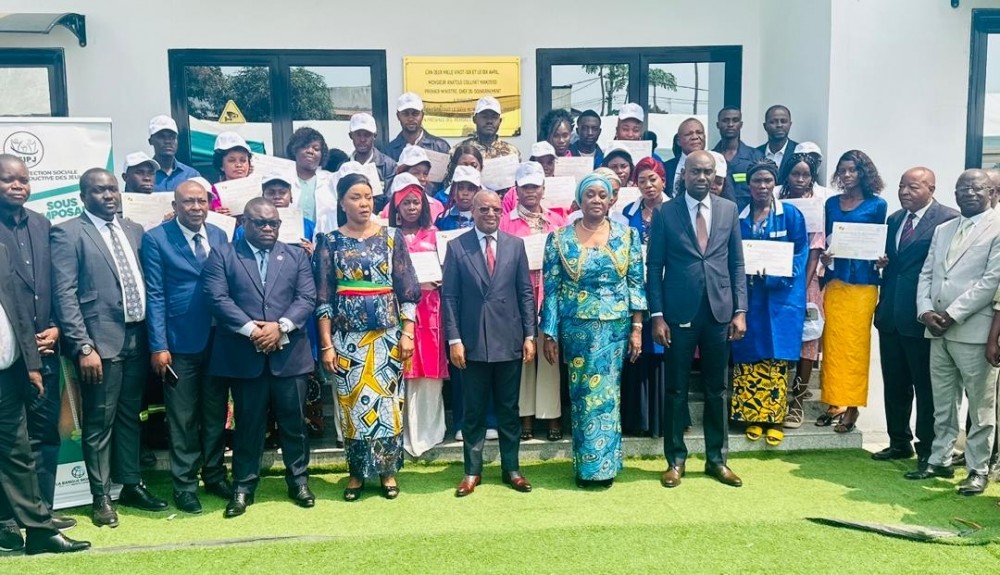
The first cohort, consisting of 2,256 young people aged 18 to 35 from the cities of Brazzaville, Pointe-Noire, Dolisie, and Ouesso, received training in twenty-two high-growth trades covering the agriculture, services, construction, and industrial sectors. The training was provided over a period of six to nine months by public and private centers as well as by qualified master craftsmen, in accordance with a competency-based approach that emphasizes professional practice.
In the presence of her colleague from the Ministry of Technical and Vocational Education—whose department oversaw the educational supervision—the Minister of Social Affairs and Humanitarian Action praised the government-wide collaboration that made this training possible. She made a point of distinguishing the government’s non-contributory social protection program from mere welfare assistance. According to Lydie Pongault, this approach is “an investment in human dignity, a lever for productive inclusion, and an instrument of economic and social transformation.” She illustrated her point by noting that the 2,256 certificates awarded are not mere administrative documents, but “a passport to a professional future and official recognition of merit and skills” acquired through a demanding journey.
Addressing the young people directly, the minister urged them to make this certificate “a starting point for a new life,” calling on them to be ambitious, diligent, and exemplary. She entrusted them with the heavy responsibility of putting their achievements to work for their families, their communities, and the nation, describing them as “the worthy ambassadors of tomorrow’s Congo.”
Furthermore, Lydie Pongault announced, on behalf of the government, the upcoming launch of a second cohort, reflecting “the government’s firm commitment to sustaining and expanding this momentum toward productive inclusion.” She reaffirmed her gratitude to the World Bank, a strategic partner in this project.
PSIPJ Coordinator Antoine Regis Ngakeni outlined the key stages of the process, from beneficiary selection to the certification assessment. He highlighted the unique nature of these training programs, which are based on “hands-on experience and professional immersion in companies , ” in line with the competency-based approach already successfully tested by the Ministry of Technical Education.
Antoine Regis Ngakeni praised the involvement of all stakeholders, including some 20 public and private training centers, several hundred master artisans, six umbrella organizations, about 50 technical and pedagogical support staff, and some 20 focal points. He emphasized that the government fully funded the training, including transportation and meal costs, as well as the provision of personal protective equipment and workplace safety insurance.
The PSIPJ coordinator also emphasized the decisive nature of this stage, which “leads to financial independence and confers dignity in society.” He noted that the project does not end there; a six-month post-training support program, including a non-repayable grant and assistance with developing business plans, is planned to help the young people get started.
It is worth noting that this project, launched in April 2024 for a three-year term, is receiving $133 million in funding from the World Bank. Its goal is to provide emergency assistance to households affected by the COVID-19 crisis and to increase access to social safety nets, with an overall target of training 5,000 young people by 2027.
Source: www.adiac-congo.com/