Congo/Justice: Legal Clinics Set Up Close to Communities
The pilot project on access to justice for women and vulnerable people was officially launched on July 14 in Brazzaville by Aimé Ange Wilfrid Bininga, Minister of Justice, Human Rights, and the Promotion of Indigenous Peoples.
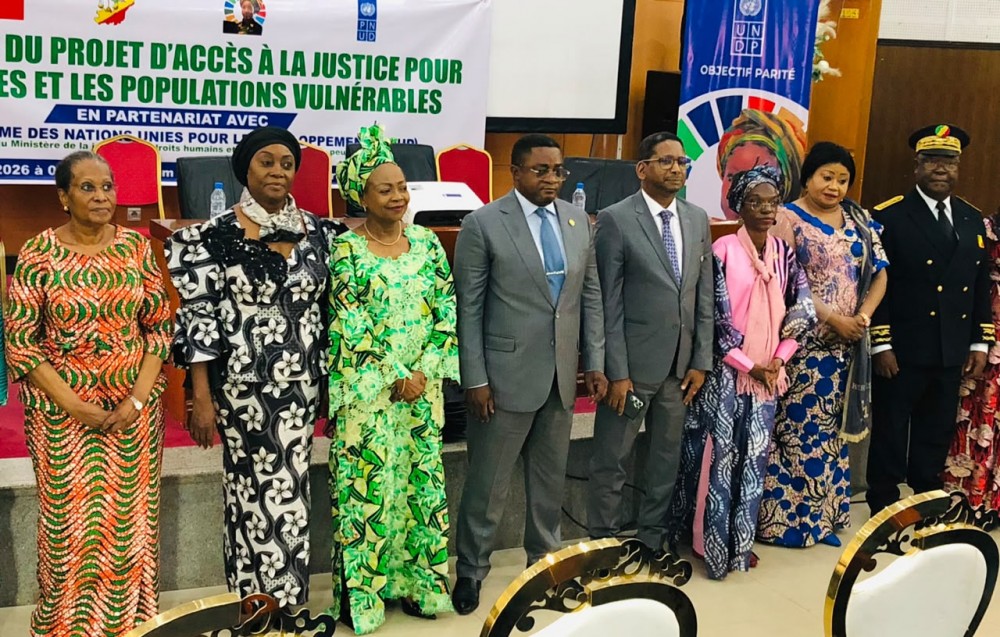
Led by the Association of Women Lawyers of Congo (AFJC), in partnership with the United Nations Development Program (UNDP), the project aims to bring justice services closer to the public, particularly women who are victims of violence and other vulnerable individuals. The initiative initially calls for the establishment of community legal clinics in the districts of Brazzaville, followed by a gradual expansion to other cities across the country, notably Pointe-Noire, Dolisie, Nkayi, and Ouesso. These spaces for listening, providing information, guidance, and legal assistance will enable those seeking justice to receive high-quality support and gain the confidence needed to assert their rights. Beyond providing assistance, these clinics will also serve as venues for legal education and awareness-raising, thereby helping to prevent conflicts, strengthen social cohesion, and promote a genuine culture of human rights.
Speaking at the event, Minister of Justice Aimé Ange Wilfrid Bininga emphasized the importance of access to justice, which is one of the essential pillars of the rule of law. “It must therefore not be a privilege reserved for a select few, but an effective right that every citizen must be able to enjoy, regardless of gender, social status, place of residence, or community affiliation, ” he stated.
In his speech, the minister also praised the Congo’s legislative progress, citing the Mouebara Law on combating violence against women, the Law on the Protection and Promotion of the Rights of Persons with Disabilities, the Law on the Rights of Indigenous Peoples, and the Law on the Protection of Children. These laws, he noted, reflect the gradual strengthening of the national legal framework for protecting the rights of vulnerable groups and promoting equality and inclusion. “These advances reflect the State’s commitment to ensuring that everyone has access to impartial justice and to promoting a society based on equality, dignity, and respect for human rights,” he continued.
The UNDP Resident Representative in the Congo, Adama-Dian Barry, painted a troubling picture of women’s access to justice worldwide. “Only 35% of women feel they have access to justice, compared to 44% of men. Fewer than 40% of women who are victims of violence report the incidents today, and fewer than 10% of them file a complaint with the police,” she noted.
These figures, she added, highlight an undeniable reality for millions of women around the world. The primary obstacle is not the lack of rights, but the inability to exercise them. She also listed the many barriers that hinder access to justice, including economic insecurity, geographical distance from courts, a lack of information and knowledge about legal mechanisms, as well as sociocultural factors such as discriminatory norms, stereotypes, economic dependence, and fear of stigmatization or retaliation.
“A justice system that is not accessible to women cannot be fully just, because women represent more than 52% of the world’s population,” she emphasized. She emphasized the need for psychological and social support to enable victims to understand the mechanisms made available to them by the state and to consent to utilizing them with the necessary support and protection.
AFJC President Jocelyne Milandou, for her part, paid a heartfelt tribute to the Minister of Justice for his institutional support, which serves as a testament to the recognition of her organization’s work over the past 35 years. She noted that her association has been actively involved in training on women’s rights, electoral disputes, advocacy, and legal and judicial support. The association has contributed effectively to the reform of the Family Code and was the first organization in the Congo to raise awareness about violence against women and sexual violence. It also participated in the drafting of the Mouebara Law. “Access to justice is not a privilege that should be reserved for certain citizens. It is a fundamental right guaranteed by our Constitution,” she stated , citing Articles 15 and 17, which enshrine equality before the law and equal rights for women and men.
Source: www.adiac-congo.com/