
Togo/PRIMA Project: Another Milestone Reached in Streamlining Cross-Border Agricultural Trade Between Togo and Benin
Togo and Benin are continuing their efforts to streamline trade along the main cross-border corridors. Earlier this month, the Corridor Consultation Groups (CCC) reviewed progress on the Regional Agricultural Market Integration Program (PRIMA), supported by the International Fund for Agricultural Development (IFAD), with the primary goal of increasing agricultural trade between the two countries by 30 percent.
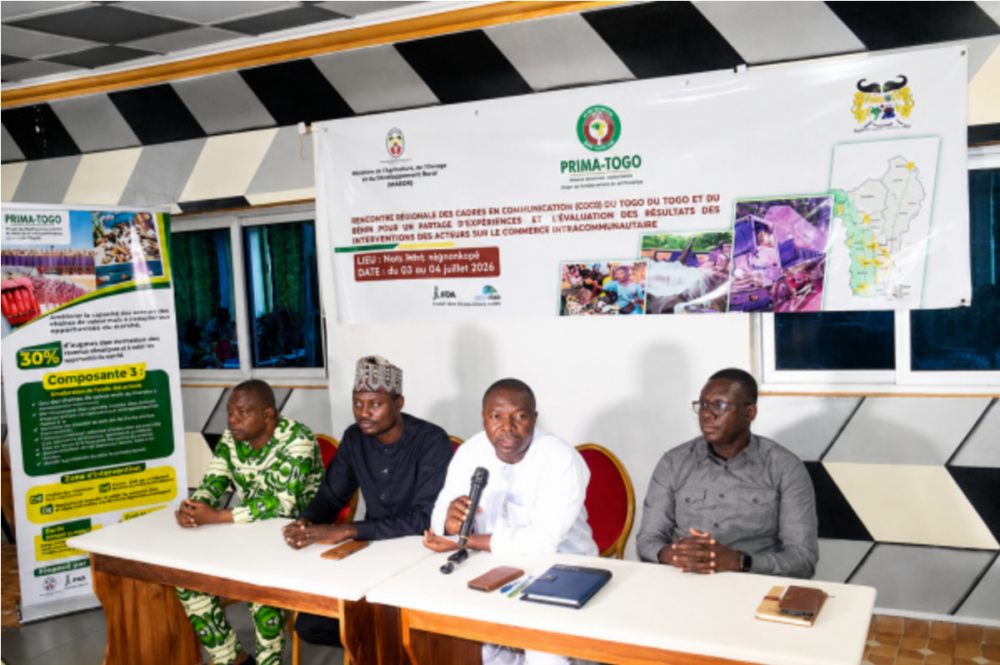
Removing Barriers to Trade
The meetings were held successively in Djougou, Dassa-Zoumé (Benin), and Atakpamé. They brought together producers, traders, transporters, inspection services, security forces, administrative authorities, producer organizations, and representatives of the Regional Agency for Agriculture and Food (ARAA).
Participants assessed the activities carried out along the various corridors, including the monitoring of trade flows, operations to ensure smooth traffic flow, and awareness campaigns on intra-community trade rules.
These stakeholders also identified the main bottlenecks hindering the smooth flow of agricultural, agroforestry, pastoral, and fishery products between the two countries.
At the opening of the Atakpamé meeting, the regional director of Agriculture for the Eastern Plateaux, Kokouvi Kounoutchi, called on participants to identify concrete solutions to “permanently remove the bottlenecks that are paralyzing trade between the two nations .”
A Program for Regional Integration
Launched for a six-year term, PRIMA is being implemented jointly by the Togolese and Beninese governments, with regional coordination provided by the ECOWAS Agricultural Research and Extension Agency (ARAA). The program combines trade facilitation, rural infrastructure development, agricultural entrepreneurship, and public-private dialogue.
Beyond consultation meetings, several investments are underway, including the development of new Planned Agricultural Development Zones (ZAAPs), the construction of storage facilities, the rehabilitation of rural roads, and the development of agricultural markets to reduce logistics costs and post-harvest losses.
Source: www.togofirst.com/