Canada/Une unité mobile de consommation supervisée, Charlottetown's imperfect Plan B
After Charlottetown City Council refused to grant the Prince Edward Island government a permit to open what would have been the province's first overdose prevention site, other options are being considered.
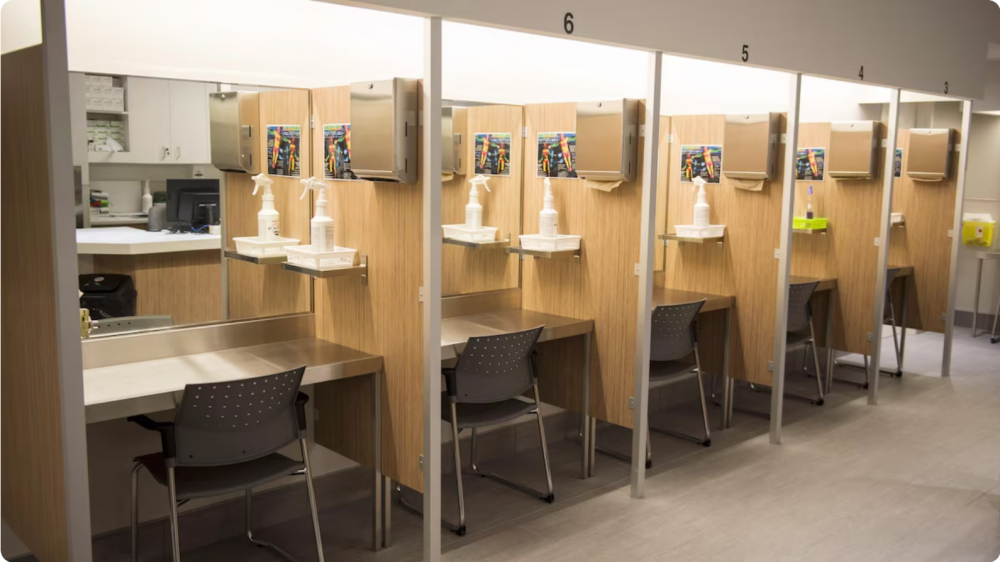
Supervised consumption sites, also known as supervised injection sites or overdose prevention centers, are part of a harm reduction approach to the use of certain drugs.
No drugs are given out. Users bring their own. Using drugs in these places, in good sanitary conditions, helps reduce disease transmission through needle sharing, fatal overdoses and waste such as syringes outside.
City council says no to the province
On Monday evening, city councillors in the provincial capital refused to allow such a site on Park Street. Bob Doiron was one of seven councillors who voted against the site. His reasoning is that if Charlottetown says no, it will force the province to deal with the problem on its own.
He is one of those suggesting that the Prince Edward Island government create a mobile unit.
Mobile units already exist in Montreal and Grande Prairie, Alberta. These are vehicles, like vans, that drive around the streets.
The principle is the same as for a supervised consumption site, except that users have to go to the vehicle.
Useful, but not ideal
Dalyce Sather-McNab, director of Northreach Society, a non-profit organization that fights HIV transmission in Alberta, estimates that 200 fatal overdoses have been prevented since the mobile supervised consumption unit opened in Grande Prairie in 2019.
The opioid crisis kills an average of 21 people a day in Canada (New Window). Almost all deaths are accidental, as the drug is often contaminated. A supervised consumption site allows responders to immediately administer naloxone, which reverses the effects of an opioid overdose.
However, Dalyce Sather-McNabb believes that a permanent, fixed location, known to those likely to need it, is much more effective, and preferable to a mobile unit that is more difficult to access.
The island's government also favors a fixed location over a mobile unit.
Dr. Heather Morrison, Prince Edward Island's Chief Medical Officer of Health, points out that a supervised consumption site is not the way to solve all the problems associated with drug abuse.It is, however, a relevant strategy in an arsenal of ways to deal with this public health crisis.
Source: ici.radio-canada.ca