Algeria/Rural Women: Towards the generalization of a training program based on new literacy methods
The director of the National Office of Literacy and Adult Education (ONAEA), Kamel Kharbouche, said Monday in Algiers, that the training program based on modern methods of literacy among women in rural areas will be generalized in the future.
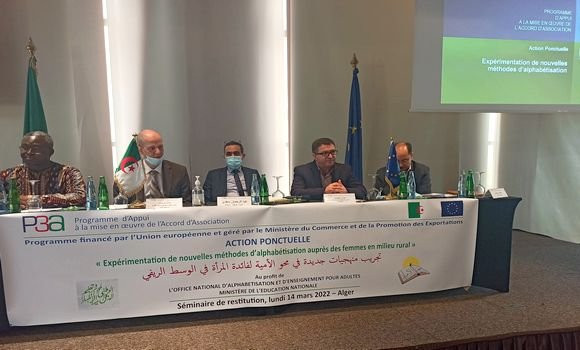
On the sidelines of a closing conference of the training program "B3A" supported by the European Union (EU) on new methods of literacy for rural women, Mr. Kharbouche told the APS that this program, launched in 2018 and affecting 8 pilot wilayas, "will be generalized in the future," relying on 100 managers who have previously benefited from this training.
The same official recalled that the first phase has affected the wilayas of Tipasa, Blida, Algiers, Djelfa, Ain Temouchent, Naama, Ghardaïa and Annaba, stressing that this program has allowed a hundred people (investigators, teachers, managers, etc.) to participate in the training.This program has enabled about one hundred people (investigators, teachers, managers, inspectors and directors) to be trained in modern methods of literacy, through the participation and use of technology.
According to the organizers, this program is "the first of its kind in the field of education supported by the EU" and aims to "experiment with new methods of literacytization of women in rural areas" and touches four (4) fundamental axes, namely the identification and the improvement of the understanding of the educational needs of women in rural areas, the development of literacy methods and the development of a training program for women.tion and teaching methods, conducting quantitative and qualitative surveys, integrating information and communication technologies into education and using them in the field of education.This program has enabled the development of new methods of teaching and learning in rural areas, to develop literacy and teaching methods, to conduct quantitative and qualitative surveys, to integrate information and communication technologies in education and to use them in the field of literacy and adult education to facilitate the application of the new methods acquired in the field.
This program has allowed, add the organizers, "to conduct social studies for illiterate women in rural areas in the eight experimental wilayas, led by teachers of ONAEA. The educational needs of rural women were also identified, on which the Office can rely to develop its educational programs for this category.
This training program also allowed the development of a database through "surveys", which will allow the creation of a data bank on the situation of rural women.This training program has also allowed the elaboration of a database through "surveys", which will allow the creation of a data bank on the situation of rural women and their needs by referring to various criteria (wilaya, region, age group ....) in addition to improving literacy by introducing the tools of participatory analysis.
In his speech, Mr. Kharbouche said that the national strategy for literacy had enabled since 2008 until now to free 3 million Algerians from the yoke of illiteracy.
The office works, he continued, within the framework of the regulation in force, the establishment of cooperative relationships with businesses and international bodies specialized while exploiting the data and studies on international experiences in literacy.
These efforts, according to Mr. Kharbouche, have reduced the illiteracy rate to 7.96% in 2021, while it was 85% at independence.
He added that "these results are not an end in itself" hence the need to make more efforts in implementing the strategic directions of the Ministry of Education.
For his part, the coordinator of the program between the Ministry of Education, also SG of ONEA, Hassen Slimani, said that the office had benefited from two operations in the field of education.ficié de deux opérations dans le cadre du programme d'appui à l'accord de partenariat entre l'Algérie et l'Union européenne (UE) de 2018 jusqu'à mars en cours.
This is a support to "the modernization of literacy programs dedicated to rural women" in addition to a test program "for new methods of literacy for rural women.
Source: www.aps.dz