Haiti/Reconstruction of the Grand Sud, a proposal for a recovery plan for the commune of Pestel to the main donors (USAID, EU, IDB, WB) and the Haitian state
Like the country, the commune of Pestel has missed several opportunities to launch its development. The Sea Festival discontinued in 1992, because of the coup d'état of September 30, 1991, was the main asset missed by the Pestelois. Thanks to its international influence, the Sea Festival could have brought a large amount of foreign currency to the local economy, which could have been used for the construction of schools, roads, agricultural enterprises and many other infrastructures necessary for the development of a community.
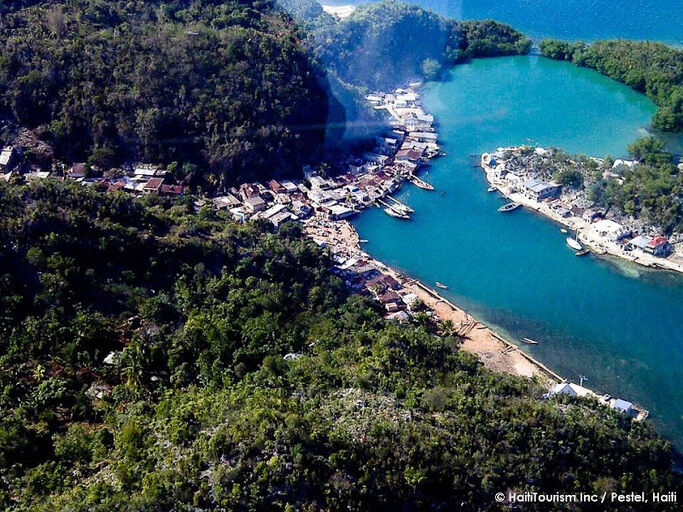
Pestel missed the train on two other occasions when it missed the opportunity to exploit the Anse-Blanche beach, which was at the time its main asset for development by foreign investors. The first time was in 1996 when the government of René Préval did not give the green light. Then, in 2012 the Lamothe-Martelly government blocked the Cayemites Investissement group. The Anse-Blanche operation represented a momentous opportunity to launch Pestel on the road to development. Indeed, it was a golden opportunity lost where hundreds of thousands of dollars of investment would transform the small island of Cayemites (3km2) into a real lever of development that would place the municipality on the world tourist map and would make the Grand'Anse-Nippes area a pole of development for the whole country.
Moreover, Pestel has not been able to take advantage of the exploitation of its coffee, from independence to the present day, to make a leap forward towards its economic take-off. In fact, the profits from coffee speculation have not been used to create small and medium-sized enterprises, organize agriculture, deploy fishing in its coastal area and invest in livestock.
Pestel, like any other commune in the country, suffers the harmful effects of the excessive centralization of public administration where everything is decided in the "republic" of Port-au-Prince. It suffers from an endemic lack of road infrastructure, drinking water, electricity, and other basic infrastructure essential to the proper development of any community.
The passage of the earthquake of August 14, 2021 has changed everything at a time when the commune was still struggling to recover from the aftermath of Hurricane Matthew. As far as we can see, all the damage caused by the hurricane was not even close to being repaired. The damaged infrastructure for the most part was ignored until now.
A sad reality that could be transformed into an opportunity, if the citizen action is well planned, oriented and well channeled. If, as DePaul Ohl/Katana says, "Strength is born out of adversity and suffering," there is reason to hope that Pestel will take off, propelled by the disaster. Pestel must take advantage of the disaster it has just experienced to give itself a new start. It must capitalize on its misfortune to build its development in coherence with its assets. Nothing says if the vision of the actors or the decision makers will be in coherence with what the commune has as resources and potential.
As noted in 2010, the recovery model proposed by donors such as IDB, World Bank, USAID, EU did not have the expected results. The problems are still visible. It was a plan based on quick, temporary and unsustainable "solutions" to major systemic problems, as Lisa Hyatt, Executive Director of Ouverture International so aptly put it in the columns of Le Nouvelliste (Stay out of the country). There was this drift in the fact that the funds allocated to reconstruction were totally directed towards humanitarian aid, to the neglect of large-scale, sustainable, structuring projects with major multiplier effects. If there is no clear vision on the part of the actors or decision makers, Pestel will suffer the same fate as the country did after 2010 and will never recover.
The people of Pestel have a vested interest in guiding the reconstruction of their commune. While it is true that there are houses to be rebuilt or rehabilitated, roads and other infrastructure to be built, it is equally important to focus on the community's sustainable development potential. That said, they must capitalize on the reconstruction funds to boost the development of their community and thus contribute to its economic self-sufficiency. This will be an opportunity to promote the creation of wealth for the commune. Thus, we propose below some guidelines:
1. Pestel must build on the assets of its maritime wealth to aim for a balanced development of its coastline, consistent with strategies of sectors related to its local productive systems, its historical monuments, its natural sites, its ecotourism potential. It is proposed to build a waterfront that will be attractive to attract more visitors. The seafront that was destroyed during the earthquake can accommodate such a project. On the initiative of Mrs. Clio Grand'Pierre and her spouse Réginald Grand'Pierre, Johnny Fignolé and the architect Addly Célestin, a master plan for the reconstruction of the waterfront is already designed. This is proof that they intend to take advantage of the disaster.
This project of "Construction of the waterfront of Pestel" will be the open door on the bay of Cayemites with its marinas, some more extraordinary than others; open door on the superb beaches of the islands with yellow or white sands with sea of emeralds glittering in the sun; open door on the islands of sand not far from the big Cayemite; and open door on the white bottoms between the Cayemites and the Basses in the middle of the bay.
2. the reconstruction of Pestel must also focus on its agricultural potential, (especially its orchards, its plantations of yams, cassava and coffee). In Hatte à Fourcaud, one of the agricultural granaries, it is proposed to build a small dam to irrigate the land in all seasons. This will be a way to increase agricultural production in the commune.
It is proposed that agricultural credit programs be set up so that funds for the development of the yam and cassava sectors are available to producers. Farmers need to create cassaveries, set up fruit and peanut processing plants, develop vacuum packaging methods and forced air cooling systems for fruits and vegetables and other perishable products in order to facilitate their delivery to the final consumer with less risk of loss and waste.
3.As an integrated zone of the protected area (Baradères-Cayemittes Complex), Pestel must consider sustainable fishing projects in order to avoid the anarchic exploitation of marine resources.3. As an integrated area of the protected area (Baradères-Cayemittes Complex), Pestel must consider sustainable fishing projects in order to avoid the anarchic exploitation of maritime resources, to protect itself against possible hazards and to prevent the disappearance of certain species from the ecosystem. The financing of a polytechnic school focused on fishing, tourism and agriculture is to be expected.
4) Hopefully, the construction of the Carrefour Zaboka-Pestel road will be taken into consideration in order to promote the interconnection between Pestel and its adjacent communes, as well as its chief town. It is also of crucial importance for us the catchment of the Bouilly Spring with a great flow, located in the fourth section and able to supply the whole commune.
All in all, the population of Pestel proposes to the donors, if they really want to help the communities to get out of the shock of the cataclysms of all kinds which put them on their knees every time they try to get up and take charge of themselves, to condition their donations to finance structuring projects up to 75% of the funds. This would help them get out of aid and make them more resilient to the next shocks that will inevitably come their way, since Haiti is a country at risk of earthquakes and vulnerable to bad weather. In the communal development plan of Pestel, they propose to decision makers a new perspective for the reconstruction of the deep south that includes the wishes of the affected populations.
Thus, the following projects can help the vulnerable communities of Pestel to increase their resilience to the hazards of nature:
1. the construction of the Pestel waterfront
2. the paving of the Carrefour zaboka-Pestel road
3. the great project of regeneration of the coffee culture
4. the great project of the revival of the cocoa culture
5. the project of setting up cassaveries in the 1st, 2nd and 3rd sections
6. the major project to increase yam production in all the communal sections
7. the major project to support fishermen
8. the major project to tap the Bouilly spring for several drinking water supply systems in the 4th, 3rd, 2nd and 1st sections
9. the project to rehabilitate the Duchity-Kaboule-Don de l'amitié section to Macaya Park
10. the large project of support to women's organizations in each section for the transformation of coffee into coffee powder, of peanuts into mamba, of fruits into jams, liqueurs of all kinds;
11- The big project of the construction of the polytechnic of Pestel;
12- project of reconstruction of the small dam of La Hatte in Fourcaud for an extension of the agricultural productivity;
12- creation of agrosylvo-pastoral activities in the area.
These proposals are not intended to block construction projects for houses destroyed or damaged by the earthquake or the construction and rehabilitation of public buildings such as schools, health centers, churches, etc. Nor do they intend to prevent the disabled and the elderly from enjoying certain benefits. These proposals are preferably aimed at discouraging and even countering projects oriented towards long-term humanitarian assistance that promote a charitable vision of assistance (basic necessities, cash transfers, etc.). We are committed to the idea of housing construction or repair projects; to this end, we suggest that decision-makers find the ideal formula that consists of to help people rebuild their houses on the traditional pattern with simply an extension plan in the yard with a latrine, a shower and a water tank. Let this be a new way of approaching development aid in Haiti!
James Saint Germain, Sociologist and professor of philosophy
jamesstgermain19@yahoo.fr
Tel: (509) 3187-1056
Ronald Étienne, former People's Deputy in the 48th and 50th legislatures
ronaldetienne1966@yahoo.com
Tel: +509 37 66 4406
Source: lenational.org