Mobile Internet revolutionizes lifestyles in Cuba
Trade, money transfer, entertainment, freedom of speech... Since its arrival in December 2018, mobile Internet has changed the lives of many Cubans. Encouraged by the state to promote economic development, this technology is also controlled by the government, which fears being overwhelmed by this new space for civil society emancipation.
By filming its entrenchment via Facebook to demand the release of a rapper last November, a collective of protesters pulled off a major coup in Cuba, where the mobile Internet, which arrived only two years ago, is revolutionising the island's daily life.
The San Isidro Movement, a collective of artists and academics hitherto unknown to the general public, has expanded its audience even beyond the borders from the house in Havana where they had been holed up for ten days, some of them on hunger strike.
Just before they were expelled by the police, 2,000 Internet users were following the live exchange between the 14 activists and doctors who had come to see them.
The next day, under the impetus of social networks relaying messages and photos, some 300 artists, some of them well-known, spontaneously gathered in front of the ministry of culture to demand more freedom of expression, an unprecedented demonstration in the island's recent history.
In Cuba, the rare attempts at demonstrations are usually announced... and discouraged by a large police deployment. This time they were caught off guard and the police had to let it go.
Since its arrival in December 2018, the mobile Internet has changed the lives of many Cubans, impacting business, civil society and speech in a country where many are still afraid to say out loud what they think for fear of sanctions.
Until then, free access to the Internet, possible since 2015, could only be achieved through paid wifi terminals installed in parks or public squares. A crowd would connect to them, often at the end of the day, sharing a slow and unstable connection.
An image that has now disappeared: with 3G then 4G, 4.2 of the 11.2 million inhabitants now surf from their phones.
Organizing solidarity
On this island with recurring shortages, the WhatsApp and Telegram groups to find food or petrol have become an essential survival kit.
On one of them, "Qué hay?" (What's up?), Wendy posts tempting photos from a supermarket: toothpaste, soap, cheese? She says, "There's a big line, I got there at 11:00 a.m. and I was able to get into the store at 3:00 p.m." (What's up?) But there's a lot of stuff in there."
Other groups allow individuals to sell or barter products: Gaby is happy to have exchanged shower gel for toilet paper and soda. Leo offers oil, soap and detergent for baby food jars.
A daily lifeline, these groups also serve to share contacts, find missing medicines in pharmacies... Previously, Cubans could only rely on word of mouth.
"Now it's much easier to find someone who has something I need," says Ricardo Torres, an economist at the University of Havana, "without these groups it would have been impossible, it would have been a matter of chance.
A movement that the state has accompanied with the creation of applications to transfer money or pay bills, and an online shopping site.
Boosting economic activity
"Clearly, it has changed our lives, now it feels so natural! Sometimes I think that two years ago we didn't have that, and I think, how could that be possible," says Marta Deus, 32, founder of the Mandao meal delivery company.
They can be seen all over Havana: recognizable by the big yellow cooler bags on the back of their scooters, Mandao's delivery men have multiplied over the past year - and even more so with the Covid-19 pandemic. Before, meal delivery was non-existent.
Every day, Mandao, which works with some 70 restaurants, receives about 100 orders, 70% of them via the application created in July 2020. "We expect to end the year with 20,000 customers," says Marta.
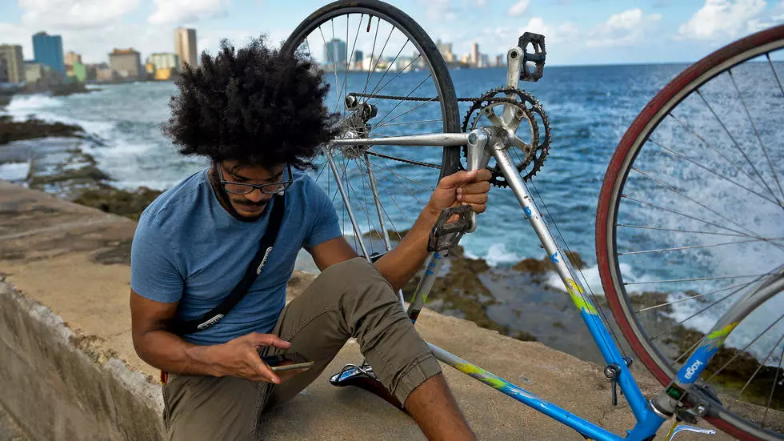
Yasser Gonzalez, 35, wanted to bring together a community of cycling enthusiasts. "Thanks to Facebook, I've started creating events," he says, and in 2015 he's organising his first big bike ride in the capital, called Critical Mass, with... four cyclists at the start.
Now that 3G has spread Internet access, more than a hundred people take part in the event every month.
Its audience has exceeded expectations. One day on her Facebook page, an official of the municipality responded to one of her messages by informing her of a project for a bicycle path on the Malecon, a famous coastal boulevard in Havana.
Now, he said, still astonished, "I can join some of their meetings where they discuss the mobility plan they plan to implement".
Such civil society initiatives have multiplied: one month after the arrival of 3G, in January 2019, a tornado hit the capital. Immediately, inhabitants organised themselves via social networks to bring food to the disaster victims, without waiting for the State as was the case before.
The government sometimes had to jump on the bandwagon and activate working groups in the face of online mobilization around animal welfare (soon to be the subject of a decree-law) or violence against women.
A double-edged sword for power
But while the mobile Internet makes daily life easier and frees up the voice of Cubans, it also chews up the State's work of surveillance, anxious to control a phenomenon that could overtake it.
When the city cancelled a planned bicycle rally in October, officially because of the pandemic, Yasser appealed to President Miguel Diaz-Canel for help. He would never have dared before.
"Dear @DiazCanelB, I am writing to you with the hope of saving the most beautiful event for our city in this difficult year 2020," he tweeted.
President Diaz-Canel, who has been in power since 2018, has made the computerisation of society a priority for his government, including opening a Twitter account.
The flip side of the coin is that some Cubans no longer hesitate to call him names or even insult him, often hidden under the anonymity of a pseudonym.
"I have no problem writing to the president: if he wants to reply, great, otherwise I'll leave it at that," Yasser said.
But a few days later, he was interrogated by State Security, the political police. "The police summoned me and I think it had something to do with the fact that I wrote to Diaz-Canel". Their message? "Warning me to stop doing that."
For freelance journalist Camila Acosta, 27, the Internet has made her job easier and her medium, the opposition site Cubanet, more visible.
Before, she used to connect via wifi in the parks, but it was "very precarious". "The real explosion was Internet on the phone," says Camila, who suddenly saw most of her contacts permanently connected.
But when she posted an image on Facebook making fun of the father of the Cuban revolution Fidel Castro, the video of a long queue at the entrance to the park was "very precarious".e of a supermarket and a photo of her being summoned by the police after a demonstration, she was fined 3,000 pesos ($125).
Decree 370, which prohibits the publication on the Internet of any "information contrary to the social interest, morals, good morals and the integrity of persons".
Defending the revolution
"Social networks and the Internet have become a permanent forum for ideological confrontation, where our arguments must also prevail in the face of enemy campaigns," the ruling Communist Party said recently.
The Internet must be used to defend "the truth about Cuba" and the revolution, the deputy communications minister, Ernesto Rodriguez Hernandez, told AFP in 2019.
Camila refused to pay the fine, exposing herself to a possible six-month prison sentence, as did around 10 of the 30 people who have been fined since January 2020.
Since then, on the Internet, "I haven't slowed down, quite the contrary," she says, confident that she often goes out into the street with "the reflex of having the phone ready to film live" her possible arrest.
"It's a bit of protection for us," she said, recalling that she did this during her last detention at the end of July, allowing her relatives to be warned and to mobilize for her release.
"For me, the Internet is the worst thing that could happen to this government", which "has not calculated what could happen", she wants to believe: "The Internet has become this space for participation that we Cuban citizens have not had for 60 years".
In recent weeks, many residents have denounced strange cuts in their ability to connect to Facebook, Twitter or WhatsApp.
In October, Telegram had become inaccessible. The NGO Access Now, along with around 20 other organisations including Reporters Without Borders, denounced a possible intentional blockage.
"The Internet makes it possible to exercise rights, including freedom of expression, and Cuba has a long history of repression of this freedom," said Veronica Arroyo, who is in charge of public policy in Latin America for this New York-based NGO.
"The government knows that the Internet is a necessary tool for (the country's) development, which is their goal, but there are things they can't control, so they put controls on it."
Source: www.france24.com