
Mali/Work will boost local development
The Prime Minister, Moctar Ouane, on Friday inaugurated the Kourouba weir-dam in the Kati Circle, 50 km from Ouélessébougou. He was accompanied, for the occasion, by several members of the government. After unveiling the stele, cut the symbolic ribbon, the head of government visited the facilities, including the engine room and fish passes. Under the gaze of the people of the Gouala region, visibly overwhelmed.
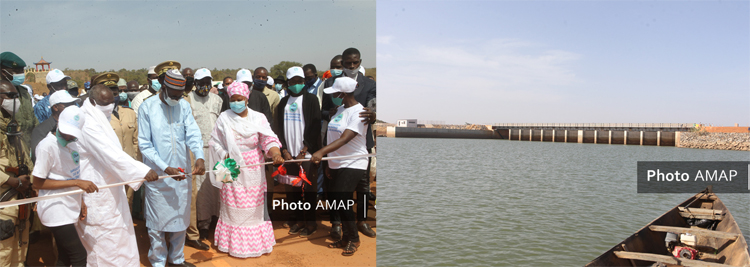
Kourouba is the capital of a commune and is a locality located on the RN7. Its name means, village located between the hill (Kulu) and the Niger River (Bâ). To get to Bamako or neighbouring Guinea, people used to make the detour via Sélingué. A long detour of 110 km which is now part of the bad memories since the provisional acceptance of the work in December 2018.
The Kourouba dam was built by the Chinese company CGC-Mali in 24 months. It opens up the two banks of the Sankarani River at Kourouba, in all seasons, thanks to the double-lane reinforced concrete road bridge and two sidewalks.
Adama Camara, a resident of the village of Dangassa, about 20 km from Kourouba, attended the inauguration ceremony. He said: "Today, the vehicles carry rice, vegetables, fruit and other goods for the weekly fair in Dangassa. We no longer have to go through Sélingué to get to neighbouring Guinea. The people of Maninkoura reach Bamako without passing through Sélingué".
Hence the satisfaction of the head of government. "I would like to salute the construction of the Kourouba dam, which is a major work because of the impact it will have on the lives of our people, especially rural ones. It will boost agricultural production, thereby helping to improve the incomes of our people and reduce poverty in the area. It will also make it possible to produce electricity," Prime Minister Moctar Ouane was delighted to say in an interview with the press.
According to the Head of Government, this achievement reflects the government's determination to fight against climatic hazards, for an agriculture that is less dependent on climatic hazards in order to enable people to cultivate at all times and live with dignity from their activities. Indeed, the construction of the Kourouba dam is the first component of the Irrigation Development Programme in the Bani Basin and Sélingué (PDI-BS). Initiated by the government with the support of technical and financial partners, its overall cost is estimated at 13.4 billion Fcfa HT/HD, entirely financed by the African Development Bank (AfDB). The programme aims to develop the significant agricultural potential through water management, a guarantee of improved living conditions for rural populations and the only way to correct the inequalities between rural and urban areas.
MORE THAN 12 BILLION FCFA
In this regard, the commissioning of the Kourouba threshold dam will make it possible, by means of water control, to free agricultural production from the vagaries of climate change and the vagaries of the Sankarani floods, explained the Minister of Agriculture, Livestock and Fisheries. Mahmoud Ould Mohamed added that the infrastructure will contribute to the achievement of the national food security strategy and poverty reduction through sustained and inclusive economic growth.
Ultimately, the results of the programme will directly affect nearly 12,000 farms, i.e. about 130,000 people, the majority of whom are young people and rural women in the intervention zones of Sélingué, Bla/San and Djenné, Minister Mahmoud Ould Mohamed stressed. The project will help to increase agro-sylvo-pastoral and fish production, with an additional production of about 52 240 tonnes of paddy rice, 3 620 tonnes of market garden produce, 4 880 tonnes of fish, 5 225 kg of meat and more than 6 million litres of milk. The total annual additional value of production for the intervention zones is estimated at more than 12 billion CFA francs, said Minister Mahmoud Ould Mohamed.
MOBILE THRESHOLD
This revitalization of local economic activity will allow, at the socio-economic level, the reduction of the rural exodus through capacity building.This revitalization of local economic activity will, at the socio-economic level, reduce rural exodus by strengthening the production capacities of the socio-professional strata of the various rural sectors, the development of SME-SMIs, job creation at the local level and rural electrification through hydroelectric production. The structure is made up of a mobile part equipped with four automatically operated directional flap gates and a fixed part including the electricity production area through a reserve of 12 passes for low head turbines. The nominal net annual electricity production is 12,200 MW/h.
The structure also consists of a 272.5 m long mobile weir whose main objective (concerning the Sélingué area) is to raise the water level of the Sankarani in order to guarantee double cropping on the Maninkoura water-controlled perimeter (1.094 ha) and the opening up of about 70 km of rural roads.
It will also increase the possibility of extending the developed areas of the Office de développement rural de Sélingué (ODRS) with an identified potential of 5 000 hectares of new irrigable land, which is scheduled for completion in the second phase. The requests have already been sent to the TFPs.
This makes it one of the most structuring projects of the PDI-BS, initiated by the AfDB in the ODRS area, the representative of the African financial institution stressed. Famory Synaba reviewed the history of the project, before commending the very appreciable disbursement rate of 98%.
Welcoming the distinguished guests, the Kourouba village chief, Niamba Konaté said he was happy to see his village welcome a Prime Minister since our country's independence. In the same vein, Mayor Issa Konaté pleaded for the completion of outstanding projects in the first phase and the development of the track linking his commune to Ouéléssébougou.
Source: afriqueactudaily.com